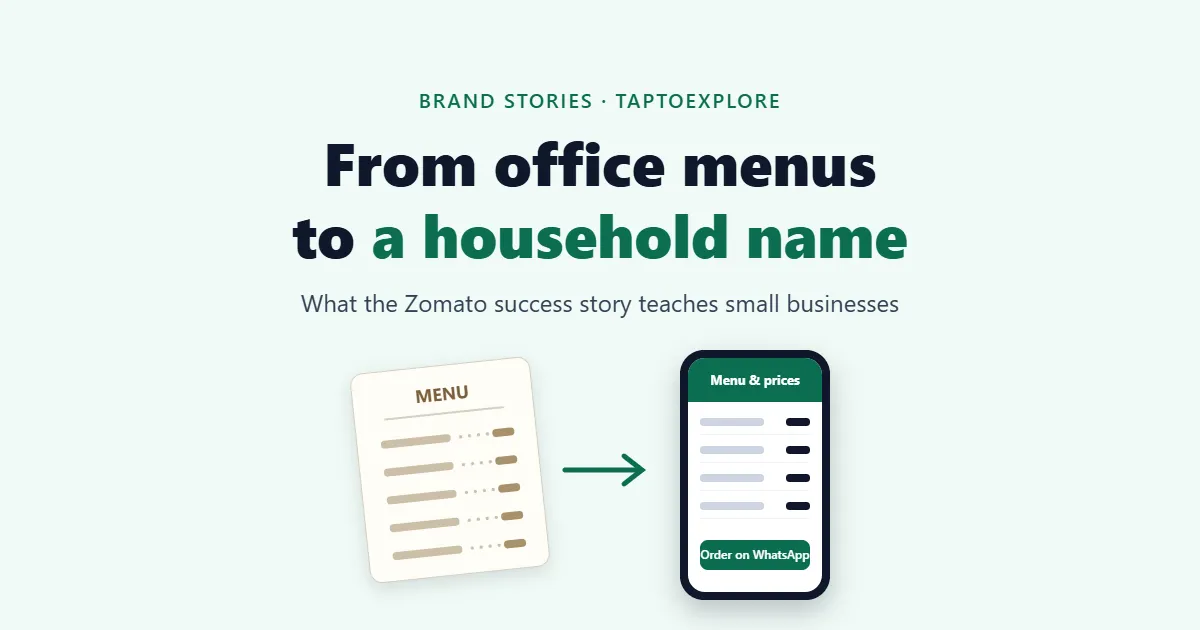
Zomato Success Story: What Small Businesses Can Learn from a Menu Put Online
In 2008, two young consultants in Delhi noticed a small, everyday problem. Colleagues were crowding around a few printed menu cards in their office cafeteria, trying to decide what to order.
The fix they tried was simple: put the menus online. That idea became Foodiebay, and Foodiebay became Zomato.
The Zomato success story is usually told as a startup tale about funding rounds and stock markets. But its starting point is far more useful for an ordinary shop owner. It began with one belief: customers want to see what you offer before they decide to come to you.
This article looks at how Zomato started, why the idea worked, and what a bakery, clinic, salon or local shop can take from it today, without a startup budget.
How Zomato Started: A Queue at an Office Cafeteria
Deepinder Goyal and Pankaj Chaddah were working at the consulting firm Bain & Company in Delhi. Many of their colleagues were young professionals living away from home, and they depended on nearby restaurants for meals.
The only way to compare options was to look at a handful of paper menus. People queued just to see them.
In an interview with YourStory in 2011, Goyal explained that the founders simply put those menu cards online. That was the first version of Foodiebay, launched in July 2008.
There was no complicated technology at the start. The value was in making information easy to find.
From Foodiebay to Zomato: Key Milestones
The business grew step by step, not overnight. Here are the main milestones, based on published reports:
- 2008: Foodiebay launches as a website listing restaurant menus.
- 2010: The company receives its first outside funding from Info Edge, the parent of Naukri.com, after about two years of running on its own money.
- Late 2010: Foodiebay is renamed Zomato. The founders wanted a name that was not limited to food listings and that avoided a possible naming conflict with eBay.
- 2011: Zomato says it has scanned menu cards for 96% of the restaurants in its directory and is live in 10 Indian cities.
- 2015: Zomato starts food delivery in India, which later becomes its main business.
- 2021: Zomato lists on the Indian stock exchanges in July.
- 2025: The parent company is renamed Eternal Limited, while Zomato continues as a brand.
The pattern is clear. Zomato did not begin with delivery, ads or a huge team. It began by helping people find information.
Why the Idea Worked: Customers Decide Before They Arrive
Zomato's early growth came from a simple change in how people choose where to eat. Before Zomato, you had to visit a restaurant, call it, or ask a friend to know what it served and what it cost.
Once menus were online, the decision moved earlier. People compared places on their phones, then walked in already knowing what they wanted.
Information comes before the sale
This is the most important lesson in the whole story. A customer who can see your products, prices and location in advance is far more likely to contact you.
A customer who cannot find that information usually moves on to a business that shows it.
Being easy to find mattered more than being big
Many restaurants listed on early Zomato were small, local places. Being visible gave them a chance to be compared with bigger names.
Visibility did not depend on the size of the restaurant. It depended on whether its information was available where customers were looking.
What the Zomato Story Means for a Small Business
You may not run a restaurant. But your customers behave in the same way. Before they call a salon, visit a clinic or order from a home baker, most of them look you up on their phone first.
Here is what they are usually trying to find.
Your products, services and prices
Zomato's first job was showing menus. For your business, the "menu" might be a rate card, a list of services, product photos or package prices.
If customers have to call just to ask the basic price, many will not bother. Showing it upfront saves time for both of you.
A quick way to contact you
Most enquiries in India now begin on WhatsApp. A visible WhatsApp or call button removes the effort of saving your number and typing a message.
If you want to set this up properly, our guide to WhatsApp integration in a digital business profile explains how it works.
A simple way to pay
UPI has made instant payments normal for small purchases. Showing your UPI ID or a payment button lets a customer pay for an order, booking or advance without extra steps.
You can read more about accepting UPI and GPay payments from your profile.
Your exact location
Zomato made it easy to find a restaurant on the map. A Google Maps link on your page does the same for walk-in customers.
Proof that others trust you
Reviews played a big role in Zomato's growth because people trust other customers more than advertising. Showing your Google rating and a few genuine reviews helps a first-time visitor feel confident.
Listing on a Marketplace vs Having Your Own Presence
Many restaurants today depend on apps like Zomato for orders, and that can be a useful channel. But a marketplace is a shared space. Customers see you next to many competitors, and these platforms usually charge a commission on orders.
Your own digital presence works differently. It is a page you control, where customers see only your business, contact you directly and pay you directly.
Most small businesses benefit from both: marketplaces to be discovered, and their own page to keep regular customers coming back.
You Do Not Need a Startup Budget to Do This
Zomato needed teams and years of investment to list thousands of restaurants. A single business only needs to put its own information online clearly.
That can be a full website, but for many small businesses a simpler option works well. A mini website or digital business profile is one mobile page with your services, prices, WhatsApp button, UPI payment, map location and reviews, shared by a link or QR code.
If you are unsure which option suits you, our guide on what a mini website is compares the choices. TapToExplore is one platform that offers this kind of profile, with a free trial to set it up.
5 Steps to Build Your Digital Presence This Week
You can apply the core lesson of the Zomato success story in a few days.
- List what customers ask most. Note the questions you answer daily on calls: price, timings, location, delivery. These belong on your page.
- Put your "menu" online. Add your main products or services with clear prices or starting prices.
- Add direct contact and payment. Include WhatsApp, a call button and your UPI details.
- Show where you are and who trusts you. Add a Google Maps link and your Google rating or a few real reviews.
- Share one link everywhere. Put it in your WhatsApp Business profile, Instagram bio, Google Business Profile and on a QR code at your counter.
Common Mistakes Small Businesses Make Online
Even businesses that are online often lose customers through small gaps. Watch for these:
- No prices at all. Even a "starting from" price helps customers decide.
- Outdated details. An old phone number or wrong timings can lose a customer permanently.
- Information spread across many places. Menu on Instagram, location on Google, payment details in a chat. Customers give up when they have to search.
- No clear next step. Every page should make it obvious how to call, chat, book or pay.
- Ignoring reviews. Not asking happy customers for reviews leaves you invisible next to competitors who do.
Key Takeaways
- Zomato began in 2008 by putting restaurant menus online, not with delivery or advertising.
- Its early success came from helping customers decide before they arrived.
- Small businesses face the same customer behaviour today, on WhatsApp and Google.
- Showing products, prices, contact, payment, location and reviews in one place makes it easier for customers to choose you.
- You can start with a simple, low-cost page and improve it over time.
Frequently Asked Questions
When and how did Zomato start?
Zomato started in July 2008 as Foodiebay, a website created by Deepinder Goyal and Pankaj Chaddah while they worked at Bain & Company in Delhi. They noticed colleagues queuing to read paper menus in the office cafeteria, so they put those menus online. The site was renamed Zomato in late 2010.
Why was Foodiebay renamed Zomato?
According to published reports, the founders renamed Foodiebay to Zomato in late 2010 for two reasons. They wanted a brand that was not limited to food listings as the business grew, and they wanted to avoid a possible naming conflict with eBay because of the similar-sounding name.
What can small businesses learn from the Zomato success story?
The main lesson is that customers decide before they arrive. Zomato grew by making menus, prices and locations easy to find online. A small business can apply the same idea by showing its products, prices, contact options, payment details, map location and reviews in one place customers can easily reach.
Does a small business need a full website to be online?
Not always. A full website suits businesses with many products or complex services. Many small shops, clinics and service providers can start with a mini website or digital business profile, which shows key information on one mobile page. You can upgrade to a full website later if your needs grow.
Is listing on Zomato or other apps enough for a restaurant?
Marketplace apps help new customers discover you, but you share the space with competitors and usually pay a commission on orders. Having your own page lets regular customers contact and pay you directly. Many restaurants use both: apps for discovery and their own presence for repeat customers.
What should a small business show online first?
Start with what customers ask most often: your products or services with prices, opening hours, location, phone and WhatsApp contact, and payment options such as UPI. Add a few real photos and genuine reviews next. Keep everything up to date, because outdated details can cost you customers.
Digital Visiting Card vs Paper Card: Real Cost Over 3 Years
November 11, 2026

Grow Your Boutique Business in Ambala with a Digital Business Profile!
November 11, 2026


Create Website In Minutes for Cafe & Restaurant | Tap To Explore
November 11, 2026